


One Department's Truth Becoming Another Department's Hallucination
“Ungoverned AI does not solve the single source of truth problem. It makes it catastrophic.”
You know that specific kind of chaos that only shows up at company offsites?
The one where you take perfectly reasonable people out of their offices, put them in a hotel conference room with bad Wi-Fi and unlimited coffee, and suddenly everyone walks in with THE vision. THE big idea. THE plan that is going to change everything.
This particular meeting was no exception, with the focus being on artificial intelligence. Each team had its own vision, and each was uniquely incorrect.
Let’s talk about how it all went down.
The Morning Chaos: Four Teams, Four Realities, Zero Coordination
They had spent the entire flight building a deck. A proper, polished, full-of-enthusiasm deck about connecting Zoho’s MCP server and HubSpot’s MCP server directly to organizational data. Not just campaign data, mind you. ALL the data. Customer records. Engagement history. Pipeline intelligence. Every piece of information the company had ever collected.
They called it “Unified Customer Intelligence.”
It had a brain graphic on it. The brain had the company logo in the center. Nobody said anything about the brain. The room had a long day ahead and everyone knew it.
The sales team walked in next. They suggested connecting Salesforce and Slack, enabling their CRM to access all internal company conversations. They called it deal velocity, which sounded very impressive until someone quietly pointed out that this would also capture salary discussions, performance reviews, and the private executive channel where leadership had been debating the restructuring.
The room heard this. The room moved on anyway. Stopping to address it would mean admitting the proposal never should have left the whiteboard.
Engineering arrived with what can only be described as a manifesto. Twenty-three AI tools. Listed, with use cases, cost estimates, and enthusiastic annotations. Claude. ChatGPT Business. Gemini for Workspace. GitHub Copilot. Amazon Q. Perplexity for research. And then, buried somewhere in the middle of the list, one tool that absolutely nobody at the leadership table had ever heard of. Flagged simply as “internal productivity” by an engineer who had been using it for six months and in those six months, he had fed it internal architecture documents, client engagement summaries, and at least two draft business proposals.
The CTO asked a question for clarity. The engineer answered that it was just for productivity. The CTO wrote something down. It wasn’t a compliment.
Finally, the business unit teams arrived with the most well-meaning pitch of all.
They wanted agents embedded directly into their line-of-business systems. Procurement agents. HR agents. Finance agents. Customer support agents. Each one connected to its own data source, running on whatever AI model the vendor had quietly bundled into the renewal contract, with a pre-ticked checkbox that nobody had ever thought to even untick.
By mid-morning, the four competing visions for organizational AI were on the table. Each one was coherent from inside the team that had proposed it. None of them had any relationship to each other. And every single one of them had silently assumed that someone else had already resolved the security, compliance, and cost questions.
That ‘someone’ had not.
The CFO Has Entered the Room
“The savings were projected, the agent costs were categorized as innovation investment, and the two numbers had never been placed on the same line of the same spreadsheet.”
The CFO had been on a call for the first ninety minutes. She walked in, got handed over a summary of the morning’s proposals. She read it without an expression.
Then she asked one question.
“If the HR agent, the procurement agent, and the finance agent are each eliminating the equivalent of one and a half headcount per department, as the business unit presentations had claimed, whose budget does the agent licensing come from?”
The room processed this.
She clarified. Not as a hypothetical. As a policy proposal.
If a department is cutting staff because AI is replacing them, then the cost of that AI should come directly out of the same budget that was paying those staff.
Not tucked under software costs.
Not buried in innovation investment.
The same line. The full equation: the agent cost, oversight cost, error recovery cost, and the savings sitting right next to all of it so everyone could see the real number.
The laughter she expected didn’t come.
What she got instead was silence.
The particular silence of a room full of senior leaders who had just realized that they had been doing math with only half the numbers.
Because here is what the CFO had just made visible.
Every single business case presented that morning had been built on the savings side only. The savings were projected, the agent costs were categorized as innovation investment, and the two numbers had never been placed on the same line of the same spreadsheet.
The CFO had placed them on the same line.
In her head. In ninety seconds. Without a deck.
That is what real AI governance looks like when it finally shows up. Not a framework. Not a policy document. Just one very direct question about whose budget it comes from.
The Token Budget Revelation: How Engineering Came Out of the Closet
The CTO had been quiet most of the morning.
Not visibly uncomfortable.
The kind of quiet that means someone is doing arithmetic of their own.
When he finally spoke, he didn’t open with a governance framework or a risk register. He opened with a number. He had added up the API consumption cost of every AI proposal in the room at a reasonable usage. Then at unreasonable usage, because that is always what happens.
Then he added the cost of every tool that was already running. Not proposed, not under consideration, actually running right now, being billed to personal credit cards and expensed as “software tools” by managers who genuinely had no idea what an API token was.
The number he put on the screen was not catastrophic.
It was instructive.
Engineering’s share was approximately three times the combined total of every other department’s proposals, because engineering had stopped proposing and started deploying.
This is the moment the room shifted from AI strategy to AI governance.
Those are not the same conversation. Organizations waste months treating them as if they are.
Strategy is: Which AI should we use?
Governance is: Who decide?, who pay? who is accountable? when a model ingests a confidential document? And the vendor’s terms of service say that is your problem?
The CTO’s solution was elegant in its simplicity. Every single AI workload in the company, regardless of which team was running it, gets tagged to a cost center.
Usage is visible.
Ownership is traceable.
No more shared abstractions.
No more “nobody’s budget.”
No more discovering in December that the tool approved in January has been running across six additional teams since April because the API key worked and nobody thought to ask whether it should.
Predictably, everyone wanted an exception.
Marketing wanted an exception for campaign automation.
Sales wanted an exception for pipeline tools.
Engineering argued, with impressive audacity given what had just been put on the screen, that development tooling should be categorized differently from production workloads. Everyone wanted an exception for their use case.
This is how organizations end up with governance frameworks.
Full of exceptions and no actual governance.
The CTO did not grant exceptions.
He granted categories.
The Governance Problem Nobody Named Until It Was Too Late to Pretend Otherwise
Let us say it plainly, because nobody in that room did.
What was happening in that room was shadow AI at an organizational scale.
Shadow AI is not a new tool being evaluated by curious employees.
Shadow AI is company data flowing through systems with no audit trail, no access controls, no guarantees about where the data lives, and no legal protection if something goes wrong. All running on the quiet assumption that it is probably fine.
It is the 2025 equivalent of shadow IT, except that shadow IT requires someone to install the software. Shadow AI requires someone to type a URL and accept a free tier terms of service agreement that nobody reads.
The instinctive response is to ban it. Bans do not work, and they have never worked, and the specific reason they do not work for AI is that the productivity differential is real and immediate and personal. The employee using an unsanctioned AI tool is not being reckless.
They are being rational. They are faster. Their work is better, and their manager is not even asking how. Banning the tool removes the productivity gain without addressing the underlying need. What you get is the same usage, but now in a hidden view.
The right response is a governance funnel.
Three questions, in sequence, with no exceptions.
Question 1: Is the tool compliant with how the organization handles data?
This is not a vendor’s trust page. This is SOC 2 Type II documentation reviewed by someone who has actually read an audit report. ISO 27001. A GDPR data processing agreement with specific commitments on how long data is retained, who the subprocessors are, and the organization’s right to delete. If the vendor cannot answer these questions with evidence, the conversation ends here.
Question 2: Does the tool fit into how the organization manages identity and access?
Can it be provisioned through a directory? Can access be revoked instantly when someone leaves? Can you pull an audit log showing who used it, when, and what they sent?
A tool that runs on shared credentials or personal accounts is not a productivity asset. It is a deferred security incident with a timestamp you will not know until after the fact.
Question 3: Who owns the token?
This is the CFO’s question and the CTO’s question arriving from two different directions. Both of them are governance questions wearing the costume of finance.
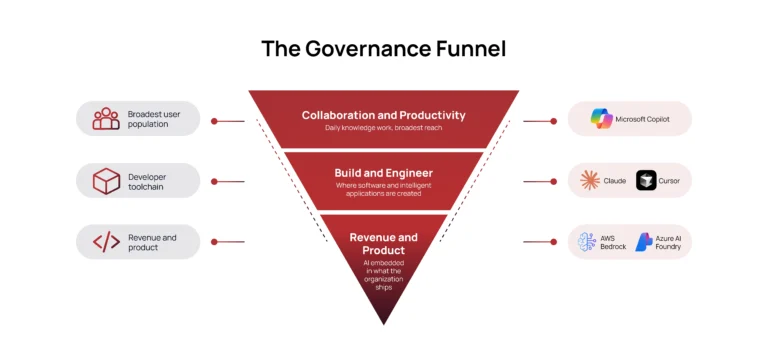
Three Layers, Not Twenty-Three Tools
The clarity that emerged from the afternoon was functional, not philosophical.
What is the AI actually doing, and for whom?
Layer 1: Workplace AI
Tools that help individuals work faster, think more clearly, summarize longer documents, draft better communications.
This is the productivity layer.
It should be provisioned centrally through enterprise agreements with appropriate data protection terms, available to everyone, and governed through the same identity infrastructure that governs everything else.
Copilot is the answer here.
Not because it is the only capable tool in this category, but because it lives inside the Microsoft 365 tenant that is already the organization’s identity perimeter.
Single sign-on. Conditional access. Audit logs.
Data stays in the organizational boundary. Workplace AI that routes outside that perimeter has a fundamentally different risk profile that most organizations have not priced into their decision.
Layer 2: Developer AI
The toolchain layer, where engineers use AI to write, review, and architect software faster. Claude plus Cursor is the sanctioned answer here.
The distinction from Workplace AI is not about capability. It is about data exposure.
A developer working with Claude in Cursor is sending code, system design, and architectural context to a model. That context needs to stay within an enterprise agreement with explicit data retention controls and clear terms about training.
This is the layer that kills organizations when left to individual engineers to sort out. When left unsanctioned, it defaults to whatever works fastest today, which changes every three months and is never the same answer twice and quietly accumulates a trail of ungoverned exposures that only surfaces when someone is doing acquisition due diligence.
Layer 3: Platform AI
The embedded intelligence inside what the organization builds or buys. AWS Bedrock and Azure AI Foundry are the sanctioned answers here because they are infrastructure, not interfaces. No chat window. No personal account. APIs, access controls, compliance certifications, and the ability to deploy models without routing sensitive workloads through shared consumer endpoints.
When a business unit wants an AI agent inside their line-of-business systems, the answer is not to let the vendor quietly bundle whatever model they chose into the renewal. The answer is to route it through organizational AI infrastructure that security and platform teams actually control.
And to apply the CFO’s budget question before the contract is signed, not after.
Everything else is unsanctioned. This includes excellent tools. It includes tools people are genuinely productive with. Unsanctioned does not mean dangerous.
It means outside the governance perimeter. The path forward is a migration path into the three sanctioned layers, and a hard stop on new unsanctioned tools accumulating while the migration is in progress.
What the Offsite Actually Decided
Offsites rarely end with clean consensus. This one was no different. It ended with three decisions that mattered.
The CFO’s agent recharge proposal went to finance policy for formal drafting. The CFO left the room still smiling, which is rarely a sign that things are going to become comfortable for anyone else.
The CTO’s token chargeback mechanism was approved in principle with an implementation timeline. Engineering’s manifest went from twenty-three tools to three sanctioned and twenty under review – a review that several vendors would quietly fail to survive.
And the organization walked out of that hotel conference room with a vocabulary it did not have in the morning.
Workplace AI. Developer AI. Platform AI.
Three layers. One governance funnel. Everything else left unsanctioned until proven otherwise.
3 Layers. 3 Truths. No Shared Hallucinations.
Here is what nobody said out loud at the offsite, but every senior leader there had learned it the hard way from some prior organizational scar.
The single source of truth is a lie.
It has always been a lie.
SAP promised it.
Salesforce promised it.
ServiceNow promised it.
Every ERP implementation in the history of enterprise software has promised it, and every one of them has delivered a very expensive negotiation between departments about whose numbers are the real ones this quarter.
AI does not solve this problem. Ungoverned AI makes it catastrophic.
Because now you do not just have departments disagreeing about numbers. You have departments whose AI layers are actively generating different versions of organizational reality, feeding those versions back into decisions, and doing it at a speed and volume that no governance committee can manually reconcile after the fact.
The three-layer model does not promise one truth. It does something more honest and more useful. It assigns each layer a truth domain it owns and is accountable for. Bounded truths with clear governance.
Not one answer for everything, but the right answer coming from the right layer, and those layers are not permitted to contradict each other without a human in the room who has the authority to resolve it.
The collaborative truth lives in the Workplace AI layer:
Copilot, provisioned through the organizational identity perimeter, is the AI closest to how the organization thinks, communicates, and decides.
What was said in the meeting. What the document actually contained before three people edited it and the original intent dissolved. What the leadership team aligned on in September that the regional teams are still debating in November.
This is organizational memory, governed and auditable.
When marketing says the campaign launched on Tuesday and sales says they never received the brief, the answer does not live in a blame thread.
It lives here, with an audit trail, under governance that both departments are bound by.
The engineering truth lives in the Developer AI layer:
Code does not negotiate. It does not have a preferred narrative. Claude working inside a developer’s environment sees what is actually being built, how it is being built, and whether it matches the architectural standards the organization committed to.
Security posture. Dependency risk. Technical debt accumulating in the codebase that the sprint velocity chart will never show.
This layer’s truth is accountability without politics. The gap between what the architect designed and what the engineer shipped is not a performance review question. It is a governance question, and the developer AI layer is where it surfaces before it becomes a production incident or a line item in an acquisition due diligence report.
The product truth lives in the Platform AI layer:
This is the most expensive truth domain in the organization because the distance between a product manager’s acceptance criteria and what an AI model does inside a deployed application can be significant, invisible, and revenue-affecting simultaneously.
When the backlog said the agent would escalate unresolved customer issues after two exchanges, and the deployed model is resolving them silently with responses that satisfy a confidence threshold but not a customer, that gap is not a product management failure. It is a governance failure.
The product truth layer asks one question that the other two layers cannot ask on its behalf:
Is what we shipped what we promised?
Not to the sprint review. To the customer. To the regulator. To the CFO who signed off on the headcount reduction based on what the agent was supposed to do.
These truths do not merge.
They are not reconciled into a single dashboard at the end of the quarter.
The collaborative truth does not override the engineering truth when they contradict each other. The product truth does not get to declare the backlog completely because the model said so.
Each layer owns its domain and answers for it: Upward, to the humans whose names are on the governance decisions when something eventually goes wrong.
This is the failure mode that no offsite presentation addressed, including the good ones.
When Copilot summarizes a meeting that a product manager uses to close a backlog item that engineering never actually built, because the summary was confident and the PM was busy and the sprint was ending, you have crossed through all three truth layers without a single governance checkpoint. That chain is three AI models.
One misread summary, zero accountability, and a customer who will find the gap before you do.
One department’s truth becoming another department’s hallucination is not a technology problem. It is what happens when organizations deploy AI faster than they deploy the governance to tell the difference.
The Question That Actually Matters
“That is not a technology strategy. That is an organizational hallucination at enterprise scale.”
Every organization has a version of this offsite happening right now. Either in a conference room or distributed across procurement approvals, vendor renewals, and individual expense reports filed under productivity software.
Everyone is buying. Everyone is building. The inventory is not reconciled, the layers are not defined, and the truth domains are not assigned.
The question every CxO should be sitting with is not which AI to use.
It is: Do you know which layer each AI belongs to, who owns the truth it produces, and what happens when two layers produce different answers?
Because right now, in most organizations, the answer to which AI is your source of truth is: all of them, simultaneously, owned by nobody, governed by nothing, and each one quietly confident that its version of reality is the one that matters.
That is not a technology strategy.
That is an organizational hallucination at enterprise scale.
And the engineer whose tool has been processing your internal documentation for six months under the line item “productivity software” would very much like you to keep treating this as a theoretical problem.
You cannot afford to.
Ravi Pravin Gokulgandhi is the Founder and Managing Director of Digital Proton Inc., a boutique IAM and Microsoft Security practice. The Rudder Framework is Digital Proton proprietary methodology for AI governance and identity-led security architecture.
Digital Counsel | digitalproton.com | Identity-first. AI-governed.

